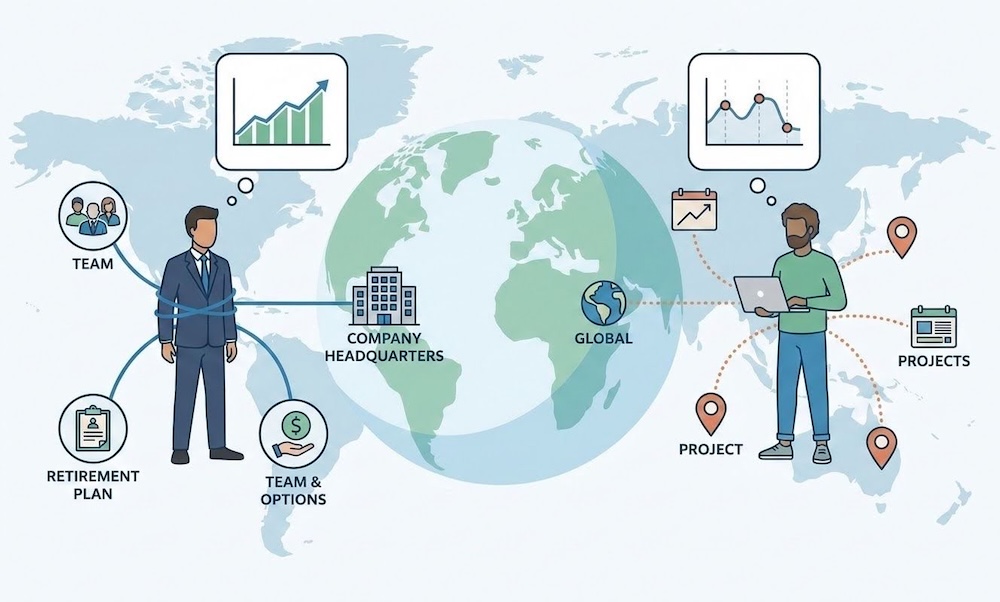

Quick answer: An EOR provider is a third-party company that becomes the legal employer for your worker in a specific country, running compliant employment contracts, payroll, tax withholding, and statutory contributions, while your business directs the employee’s day-to-day work.
Key Takeaways
- An Employer of Record (EOR) provider becomes the legal employer in-country, handling contracts, payroll, tax, and statutory benefits while you manage performance and delivery.
- EOR is most useful when you want to hire in a new country without setting up a local entity, or when you need speed with lower compliance exposure during market entry.
- EOR can reduce employment compliance risk (contracts, payroll errors, misclassification, termination mistakes), but it does not automatically remove Permanent Establishment (PE) risk—role scope and commercial activity still matter.
- Strong EOR selection depends on local legal coverage, payroll reliability, employee support, and clear risk terms—not just “global coverage”.
- EOR is often a stage in a hiring model: many companies start with EOR, then move to entity setup or a hybrid model as headcount and revenue justify it.
- If you need Asia-first hiring with senior oversight, Eos Global Expansion supports compliant expansion with a boutique approach.
The Problem EOR Solves for Global Employers
International expansion creates two immediate operational risks:
- hiring locally without understanding employment rules, and
- relocating employees without the right compliance structure
Both lead to the same issues—non-compliant contracts, payroll mistakes, benefit gaps, and costly disputes. An EOR provider reduces this risk by running local employment properly, without requiring you to set up a local entity on day one.
If you are comparing hiring models, start with Differences Between EOR & PEO: Which Hiring Model Solves Your Business Problem
What Does An EOR Provider Do?
In practice, an EOR provider typically covers:
- Employment contracts aligned to local law (probation, notice, working time, leave, mandatory clauses)
- Payroll processing (salary calculations, payslips, payment schedules)
- Tax and social contributions (withholding, employer contributions, filings)
- Statutory benefits and local standards (annual leave, sick leave, maternity/paternity, minimum wage rules—see ILO guidance on different minimum wage systems—and overtime requirements)
- Onboarding and offboarding (right-to-work checks where required, compliant exits)
- Support for compliant terminations (process, documentation, final pay, notice rules)
- Optional add-ons such as immigration support and benefits packaging, depending on country and provider
Want a deeper explanation of why businesses use this model to expand internationally? Read Why Hiring An EOR Provider Supports Compliant Global Expansion.
Want the practical checklist view? See EOR Compliance Checklist for Global Employers in 2026.

How An EOR Works Step-By-Step
A clear workflow helps you judge whether an EOR partner can actually run employment well.
- Role + country scoping (employment type, work location, start date, compensation, benefits expectations)
- Compliance review (classification, contract terms, statutory benefits, payroll obligations)
- EOR employment contract issued (signed under the EOR’s local entity)
- Your business manages the work (objectives, performance, delivery)
- Monthly payroll and filings (tax withholding, social contributions, reporting)
- Lifecycle support (leave, contract updates, promotions, termination support)
For companies planning ahead, see Global Hiring Trends 2026: How EOR & PEO Models Are Redefining Expansion to understand how this operating model is being used at scale.
EOR vs PEO vs Staffing Agency
One of the biggest sources of confusion is comparing models that solve different problems.
| Model | Who is the legal employer? | Best for | Watch-outs |
| EOR | EOR provider (local entity) | Hiring employees in-country without your own entity | You still manage day-to-day work; the provider must be strong on local legal compliance |
| PEO (Professional Employer Organisation) | Usually your entity (co-employment varies by market) | When you already have an entity and want HR support | Often not a substitute for incorporation; co-employment structure may not exist in every country |
| Staffing agency | Agency (often for temporary placements) | Short-term resourcing | Designed for temporary staffing, not long-term employment compliance; responsibility and protections differ |
Key difference between an EOR and a staffing agency:
Staffing agencies are primarily built to supply talent quickly, often for short-term needs.
An EOR is built to employ your worker properly in-country—contracts, statutory benefits, payroll compliance, and compliant exits—while you retain control over the work.
That’s why EOR is typically the better fit when you want a long-term hire in a country where you do not have an entity.
Why Use an EOR to Expand Internationally?
If you are entering a new country, the question is rarely “can we run payroll?” It’s whether you can run employment compliance end-to-end without creating exposure.
Here’s how an EOR typically creates value:
1) Legal Compliance You Can Operationalise
Employment rules vary heavily by country. Errors usually surface at audits, disputes, and exits. An EOR reduces contract and payroll missteps by using local employment infrastructure.
2) Payroll and Tax Administration Across Borders
Multi-country payroll includes local withholding, employer contributions, reporting schedules, payslip rules, and payment timelines. An EOR runs this as the legal employer.
3) Faster Market Entry With Controlled Risk
EOR is often used as an alternative to immediate local entity setup. The advantage is speed, but the real benefit is controlled compliance while you test the market.
4) Risk Transfer (With Clear Boundaries)
An EOR takes on employer obligations, but you still carry business risk. Internal controls still matter (job scope, sign-off authority, client-facing decision-making).
5) Flexibility As You Scale
EOR is commonly a first stage. Many companies move to entity setup or a hybrid model when headcount, revenue, or regulatory requirements justify it.
For a structured way to decide, use our EOR vs Local Entity Setup Decision Framework For Global Expansion.
If you want to evaluate provider fit before signing, read How to Choose an EOR Service?

Does an EOR reduce Permanent Establishment risk?
An EOR can reduce PE exposure compared with informal hiring, but it does not remove PE risk on its own.
PE risk is usually triggered by business activity (especially revenue-generating activity, authority to conclude contracts, or a fixed place of business), not payroll mechanics alone.
Use an EOR alongside a PE review of roles, sales authority, and operating model.
What An EOR Typically Does Not Do
This is where expectations need to be clear:
- It does not replace your management responsibility (performance, targets, workload)
- It may limit direct control over certain HR actions because formal steps must follow local law and the EOR’s employing processes
- It does not automatically solve PE risk if your commercial footprint triggers it
- It is not always the cheapest option once you have a larger, stable team in-country (entity setup can become more economical later)
How to Choose an EOR Provider (Due Diligence Checklist)
An EOR is not a commodity purchase. The right partner should protect you at the points where most global hiring issues happen: contracts, payroll, statutory compliance, and exits.
Use this checklist to validate operational capability before you sign.
Compliance and Legal Coverage
- Do you use your own entities in-country, or partners? If partners are used, what governance and accountability model sits behind them?
- Who provides local legal support for contracts, disciplinary processes, and termination guidance?
- How are employment terms kept current when labour rules change (and how quickly are updates implemented)?
Payroll Operations
- What are the payroll cut-off dates, pay schedule, and the process for correcting payroll errors?
- Which statutory filings and payments are included (tax, social security, reporting), and what sits outside scope?
Employee Experience
- How are benefits set and maintained against local expectations (statutory and market-standard)?
- Who supports employees day-to-day: a local HR contact or a central helpdesk, and what are response times?
Commercial and Risk Controls
- What indemnities exist, what are the limits, and what situations are excluded?
- How are disputes, terminations, and final settlements handled, including documentation, timelines, and approvals?
Choose an EOR provider that can prove local legal coverage, consistent payroll execution, clear employee support, and defined risk terms.
For a full selection framework, see: How To Choose an EOR Service: A 2026 Guide.
How Eos Supports EOR Hiring Across Asia and Beyond
Eos Global Expansion supports market entry and compliant hiring with a boutique approach: you work directly with senior professionals, with hands-on oversight across onboarding, payroll transitions, and compliance workflows.
For coverage beyond Asia, Eos works with Hightekers to support compliant hiring across 27+ countries, enabling continuity as businesses expand across Europe, North America, and the Middle East.
Ready to expand globally with confidence?
Speak with Eos Global Expansion to review your target countries, hiring model, and compliance risks—so you can hire faster without compromising control.
If your immediate need is deciding where to hire first, see Top countries for EOR hiring in 2026 (and why Southeast Asia leads).
FAQs
Is an EOR provider the same as a payroll provider?
No. Payroll is one function. An EOR is the legal employer and is responsible for compliant employment contracts, statutory benefits, and employment obligations in-country.
Can an EOR help us hire without setting up a local entity?
Yes. That is one of the main reasons companies use EOR services: the EOR employs the worker through its local entity so you can hire faster without incorporating first.
Who manages the employee day-to-day when using an EOR?
You do. The EOR handles employment and payroll compliance, while you set goals, assign work, and manage performance.
Does an EOR remove Permanent Establishment risk?
No. It may reduce exposure compared with informal hiring, but PE risk depends on business activity and authority (especially sales and contracting). Use an EOR alongside a PE review of role scope and revenue generation.
What is the difference between an EOR and a staffing agency?
An EOR is designed for compliant long-term employment through a local employing entity. A staffing agency is typically for short-term placements and recruitment-led resourcing, with different legal intent and risk coverage.
How do we assess if EOR or entity setup is better for our next country?
If the market is still being tested, EOR is usually the lower-friction route. If headcount and revenue concentration justify full local control, entity setup often becomes the next step.
If you want a structured assessment across multiple countries, speak with an Eos’s consultant now.