

Key Takeaways
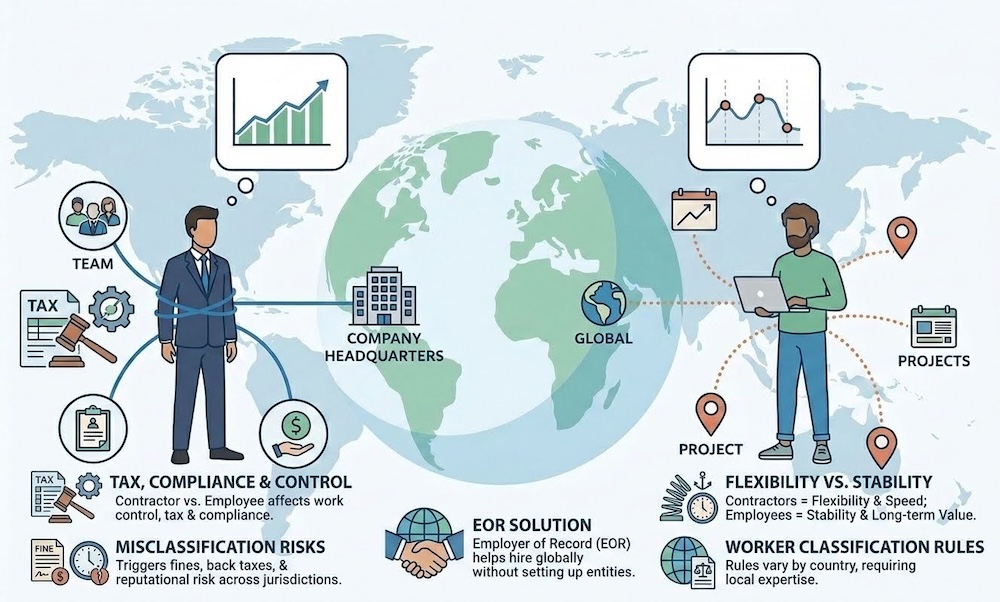
- The difference between a contractor and employee affects tax, compliance, and control over work.
- Misclassification can trigger fines, backdated taxes, and reputational risk across multiple jurisdictions.
- Contractors offer flexibility and speed; employees provide stability and long-term value.
- Worker classification rules vary by country, requiring local expertise to stay compliant.
- Employer of Record (EOR) solutions help businesses hire employees globally without setting up entities.
What Is The Difference Between A Contractor And Employee?
The difference between a contractor and an employee lies in control, legal status, and obligations.
- Employees work under direct supervision, follow company policies, and receive statutory benefits.
- Contractors operate independently, provide services under a contract, and manage their own taxes and benefits.
For global hiring, this distinction determines:
- Payroll and tax responsibilities
- Employment rights and protections
- Legal exposure across jurisdictions
According to the International Labour Organization (ILO), the employment relationship determines access to workers’ rights, benefits, and protections, as well as the corresponding obligations of employers under national labour laws.
Contractor Vs Employee: Key Differences Explained
Understanding the difference between employees and contractors is essential for structuring compliant, cost-effective hiring across markets.
| Factor | Employee | Contractor |
| Control | Employer controls work, hours, and methods | Works independently with minimal supervision |
| Tax | Employer handles PAYE, social contributions | Responsible for own tax filings |
| Benefits | Statutory benefits (leave, pension, insurance) | No employer-provided benefits |
| Legal Protection | Protected by labour laws | Limited legal protections |
| Cost Structure | Higher long-term cost | Lower short-term cost |
| Flexibility | Less flexible | Highly flexible |
Decision Insight:
Use employees for long-term growth and core roles. Use contractors for project-based or short-term needs.
Pros And Cons Of Hiring Contractors Vs Employees
Choosing between contractors and employees affects cost, control, compliance, and long-term growth.
Hiring Contractors
Advantages
- Faster onboarding across borders
- Lower upfront costs
- Flexible workforce scaling
- Access to specialised skills
Disadvantages
- Limited control over work output
- Higher misclassification risk
- Less loyalty and long-term retention
- No exclusivity
Hiring Employees
Advantages
- Greater control and accountability
- Stronger cultural integration
- Long-term business continuity
- Legal protection of IP and data
Disadvantages
- Higher compliance and payroll costs
- Slower hiring process
- Requires local entity or EOR
- Ongoing statutory obligations
How To Classify A Worker As Contractor Or Employee
Classification depends on three core factors used globally:
1. Level Of Control
- Does the company control how, when, and where work is done?
- High control indicates an employee relationship
2. Financial Dependency
- Is the worker economically dependent on one company?
- Dependence suggests employee status
3. Nature Of Relationship
- Is the work ongoing or project-based?
- Permanent roles typically indicate employees
Authorities such as HMRC (UK), IRS (US), and IRAS (Singapore) apply similar classification frameworks to determine whether a worker is an employee or contractor based on control, financial arrangements, and the nature of the working relationship.
Sources:
- HMRC – Employment Status Guidance
- IRS – Independent Contractor vs Employee
- IRAS (Singapore) – Employee vs Self-Employed
Practical Insight:
If you treat someone like an employee, regulators will likely classify them as one.
Tax Implications For Contractors And Employees
Tax treatment differs significantly between employees and contractors, affecting compliance responsibility and total cost.
Employees
- Employer deducts income tax and social contributions
- Mandatory contributions (e.g. National Insurance, pension schemes)
- Employer is responsible for payroll compliance and reporting
Contractors
- Responsible for their own tax filings
- May operate through personal service companies
- May be subject to VAT/GST depending on jurisdiction
Example (UK):
- Employees fall under PAYE
- Contractors may be subject to IR35 rules
Global Impact:
Different tax regimes increase the risk of double taxation, unpaid liabilities, or penalties if worker classification is incorrect.
Legal Risks Of Misclassifying Employees As Contractors
Misclassification is one of the most common and costly risks in global hiring.
Key Risks
- Backdated taxes and penalties
- Employee claims for benefits and entitlements
- Legal disputes and litigation
- Reputational damage
In some jurisdictions, penalties may include:
- Retroactive social security contributions
- Fines per misclassified worker
- Criminal liability in severe cases
According to the European Council, false self-employment (misclassification) undermines workers’ rights and is subject to enforcement measures across EU member states.
In Japan, authorities similarly emphasise that worker classification determines eligibility for labour protections, social insurance, and employer obligations under labour law.
Bottom Line:
Misclassification is not a cost-saving strategy—it creates long-term legal and financial exposure.
When Should You Hire A Contractor Vs An Employee?
The right choice depends on your expansion stage, risk tolerance, and operational needs.
Use Contractors When:
- Entering a market quickly
- Testing new regions
- Hiring for short-term projects
- Accessing niche expertise
Use Employees When:
- Building long-term teams
- Protecting intellectual property
- Managing core business functions
- Scaling operations sustainably
How Worker Classification Impacts Global Hiring Strategy
Worker classification directly affects:
- Speed of expansion
- Cost predictability
- Compliance exposure
From a cost and speed perspective:
- Contractors allow rapid entry but increase compliance uncertainty
- Employees require structure but reduce long-term risk
This is where Employer of Record (EOR) becomes critical.
How EOR Helps Balance Contractor Vs Employee Hiring
An Employer of Record (EOR) helps businesses manage the trade-off between speed, compliance, and control when hiring globally—especially when deciding between contractors and employees.
An EOR enables you to:
- Hire employees legally without setting up a local entity
- Manage payroll, tax, and compliance across multiple jurisdictions
- Reduce misclassification risk when transitioning from contractor-based hiring
This is particularly relevant for common decisions such as:
- Contractor vs employee tax differences
- Contractor vs employee compliance risks
- When to hire a contractor vs full-time employee
Eos Global Expansion delivers compliant hiring across Asia, Europe, and other key markets through established local expertise and partnerships.
How Eos Global Expansion Supports Global Hiring
Eos Global Expansion helps businesses choose the right hiring model based on speed, cost, and compliance requirements.
Our boutique approach means you work directly with senior professionals who combine legal expertise with cultural understanding—providing clear, market-specific guidance at every stage.
Whether you are comparing:
- Contractor vs employee cost structures
- EOR vs contractor hiring models
- Global payroll vs contractor payments
Our team provides practical recommendations aligned with your expansion strategy.
If you’re planning your hiring strategy, speak with our team to get practical guidance tailored to your expansion plans.
Conclusion: Making The Right Hiring Choice Globally
The difference between a contractor and employee goes beyond structure—it shapes your compliance, cost, and growth strategy.
Businesses that classify workers correctly:
- Reduce legal exposure
- Improve workforce stability
- Scale across markets with confidence
Eos Global Expansion combines over 20 years of experience with local expertise to support compliant global hiring.
Speak with our team today to structure your workforce correctly from the start.
Related Insights For Global Hiring Strategy
- What is Cross-border Hiring & How Does it Benefit Businesses?
- Global Workforce Planning for SMEs: Hiring Across Asia Without Complexity
- Top Countries for EOR Hiring in 2026 (And Why Southeast Asia Leads)
- 6 Key Challenges of Cross-border Hiring And How Global Employers Can Overcome Them
- EOR vs Local Entity Setup: A Strategic Framework for Global Expansion
FAQs
1. When should a business hire a contractor vs an employee?
Hire contractors for short-term projects, market entry, or specialised expertise. Hire employees for core roles, long-term growth, and functions requiring control and continuity.
2. What are the compliance risks of hiring contractors instead of employees?
The primary risk is misclassification. If a contractor is effectively treated as an employee, businesses may face backdated taxes, penalties, and claims for statutory benefits.
3. What are the tax differences between a contractor and an employee?
Employees have taxes and social contributions handled by the employer through payroll. Contractors manage their own tax filings and may also be subject to VAT or GST depending on the jurisdiction.
4. Is hiring contractors cheaper than employees?
Contractors typically have lower upfront costs, but misclassification risks and limited long-term stability can increase overall costs. Employees involve higher fixed costs but offer greater compliance certainty and retention.
5. Can you switch from contractors to employees when expanding globally?
Yes. Many businesses begin with contractors for speed, then transition to employees—often through an EOR—to reduce compliance risk and support sustainable growth.
6. How does using Eos Global Expansion compare to hiring contractors directly?
Eos Global Expansion enables businesses to hire employees through an Employer of Record (EOR) without setting up a local entity. This provides a compliant, structured alternative to contractor hiring—combining speed with reduced legal and tax risk.