
Key Takeaways
- An EOR is the legal employer in-country; a PEO supports co-employment where the client remains the legal employer.
- EOR enables hiring without a local entity; PEO typically requires an incorporated entity in the jurisdiction.
- Payroll liability, tax exposure, and compliance responsibility are not equal across the two models.
- Choosing the wrong structure can increase permanent establishment (PE) exposure and regulatory risk.
- Eos Global Expansion structures EOR and PEO models based on expansion stage, jurisdiction, and risk profile.
What Is the Core Legal Difference Between EOR and PEO?
The difference is structural, not operational.
- Under an Employer of Record (EOR) model, the provider is the legal employer in-country.
- Under a Professional Employer Organisation (PEO) model, the client remains the legal employer, and the PEO supports HR and payroll under a co-employment framework.
That single distinction determines:
- Who signs the employment contract
- Who registers for payroll tax and statutory contributions
- Who carries employment compliance liability
Before choosing either model, companies should evaluate their expansion structure through compliant Global PEO and EOR services.
What Is an Employer of Record (EOR)?
An Employer of Record lets a company hire employees in a foreign country without setting up a local legal entity.
Under EOR:
- The EOR is the employer on paper and holds the employment contract
- Payroll, tax withholding, and statutory contributions are managed locally
- Employment compliance is managed through the EOR’s local employing structure
- The client retains day-to-day operational control (work, performance, priorities)
EOR is most suitable when you need:
- Market entry without incorporation
- Fast hiring to validate demand or delivery
- Multi-country hiring without building separate HR and payroll infrastructure
- A structure that supports early-stage governance while commercial strategy is still forming
EOR is primarily a market entry and early-scale structure.

If you need a practical breakdown of what an EOR actually does day-to-day, read What An Eor Provider Is And How Employer Of Record Works
For market outlook context, see: Global Hiring Trends 2026: How EOR & PEO Models Are Redefining Expansion
What Is a Professional Employer Organisation (PEO)?
A Professional Employer Organisation operates through co-employment, where the client remains the legal employer.
Under PEO:
- The client must have a registered local entity
- The client remains the legal employer
- The PEO supports payroll administration and HR operations
- Statutory and tax liability ultimately remains with the client entity
PEO is most suitable when:
- Long-term market commitment is confirmed
- Headcount and revenue justify incorporation
- Internal governance (legal, finance, HR) exists or is being formalised
- The priority is operational efficiency inside an established entity
PEO supports entity-based operations. It does not replace incorporation.
For broader industry direction, see: PEO Market Trends 2026: The Shift Toward Strategic Global Partnerships

EOR vs PEO: Structural Comparison
| Structural Factor | EOR | PEO |
| Legal Employer | Provider | Client company |
| Entity Required | No | Yes |
| Payroll Registration | Managed by EOR | Client responsibility |
| Tax Filing Liability | Managed in-country | Client retains liability |
| Speed to Hire | Immediate | Dependent on entity readiness |
| PE Risk Exposure | Lower during early stage | Requires tax modelling |
| Best Use Case | Market entry | Established presence |
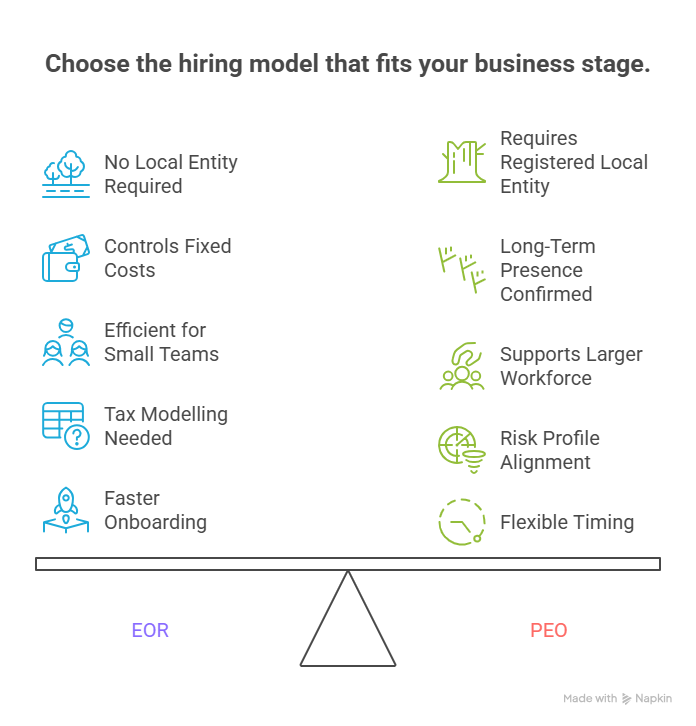
Executive Decision Flow: Should You Use EOR or PEO?
Use this framework to decide based on structure, not preference.
Step 1: Do You Have a Registered Local Entity?
- No → PEO is not legally viable. Consider EOR.
- Yes → Proceed to Step 2.
Step 2: Is Market Entry Still Being Validated?
- Yes → Use EOR to control fixed costs and reduce early-stage exposure.
- No, long-term presence confirmed → Proceed to Step 3.
Step 3: Does Headcount Justify Entity Governance Overhead?
- Small or mid-sized team → EOR may remain efficient.
- Larger, stable workforce → PEO may support entity-backed scaling.
Step 4: Has Permanent Establishment Exposure Been Modelled?
- No → Conduct tax modelling before choosing either structure.
- Yes → Align hiring model with assessed risk profile.
Step 5: Is Speed to Hire Critical?
- Immediate deployment required → EOR enables faster onboarding.
- Timing flexible → Entity-backed PEO may be suitable.
Executive Summary
- Choose EOR when speed, flexibility, and market validation matter most.
- Choose PEO when you already have an entity and need HR/payroll support inside that structure.
- Reassess as headcount, cost base, and revenue concentration increase.
- Hiring structure should evolve with business maturity—not remain static.
What Are the Compliance Risks of Choosing the Wrong Model?
When your hiring model does not match your expansion stage, common failure points include payroll registration gaps, contractor misclassification, duplicate tax exposure, and PE risk escalation.
Companies often confuse “HR admin support” with “legal employment responsibility”. These are not the same.
For step-by-step hiring safeguards, review: EOR Compliance Checklist for Global Employers in 2026
How Should HR and Finance Leaders Evaluate EOR vs PEO?
This decision must reflect risk tolerance and time horizon, not just operational convenience.
HR Considerations: Local employment law exposure, contract enforceability, termination risk, and benefits compliance.
Finance Considerations: Incorporation cost, payroll tax obligations, contribution forecasting, corporate tax modelling, and audit readiness.
Strategic Considerations: Market commitment duration, revenue concentration, headcount trajectory, and risk tolerance.
For detailed provider selection criteria, read: How to Choose an EOR Service? A 2025 Guide
How Do EOR and PEO Affect Permanent Establishment Risk?
Permanent establishment (PE) exposure depends on how the business operates in-market, including legal employer status, revenue-generating activity, and decision-making location.
EOR can reduce early structural exposure by separating employment from incorporation during entry. PEO requires careful tax modelling because the client retains legal employer status and operates through an entity.
For broader expansion governance, see the strategic framework in What Is Global Expansion in Business?
How Eos Structures Compliant EOR and PEO Solutions
Eos Global Expansion aligns hiring structure with expansion stage, jurisdictional risk and long-term commercial objectives.
Eos supports this by:
- Assessing entity requirements and regulatory thresholds
- Structuring compliant EOR engagement where incorporation is not yet justified
- Supporting PEO administration where a local entity already exists
- Aligning payroll governance with tax and PE exposure
- Coordinating compliance oversight across 27+ countries
The objective is structural alignment—so your hiring model supports scale without increasing risk.
Conclusion: Structure Determines Risk and Scalability
EOR and PEO are not interchangeable.
- EOR enables compliant hiring without entity setup.
- PEO supports administrative efficiency within an existing entity.
- The wrong choice increases tax and compliance exposure.
- The right structure protects scalability and reduces avoidable rework.
Want a clear view of what you’re outsourcing? Read What An EOR Provider Is and What It Manages For You.
Ready to choose the right hiring model with confidence?
Speak with Eos Global Expansion now to assess your target markets, entity position, and compliance exposure before you hire.
FAQs
1. Is EOR the Same as PEO?
No. An EOR becomes the legal employer in-country and manages compliant employment. A PEO operates under co-employment, where the client remains the legal employer and must already have a registered local entity.
2. Do Companies Need a Local Entity to Use a PEO?
Yes. A PEO requires the company to have an incorporated legal entity in the jurisdiction. Without incorporation, a PEO cannot legally operate.
3. When Is an EOR More Appropriate Than a PEO?
An EOR is more appropriate when entering a new market without incorporation, testing commercial viability, or hiring a small team before committing to entity setup.
4. Does Using an EOR Remove Permanent Establishment Risk?
Not automatically. While EOR may reduce early structural exposure, permanent establishment risk depends on revenue-generating activity, contract authority and operational substance. Tax modelling is still required.
5. Is a PEO Lower Risk Than an EOR?
Not necessarily. Under a PEO model, the company retains legal employer status and regulatory liability. Risk exposure depends on how well payroll, tax and employment compliance are structured.
6. How Does Eos Help Determine the Right Hiring Model?
Eos assesses headcount projections, market commitment, tax exposure and regulatory requirements. Based on this, Eos recommends whether EOR, PEO or a phased transition model best aligns with the expansion strategy.
Speak to our global expansion specialists to evaluate your hiring structure before entering a new market.