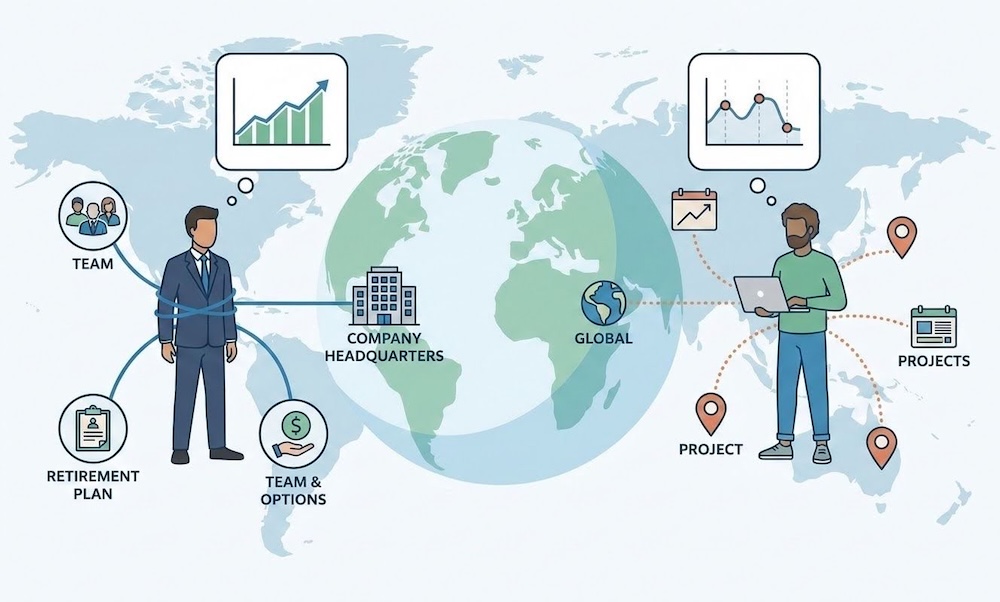

Short answer:
EOR payroll transfers employment and payroll compliance to a local legal employer, while self-managed global payroll keeps full responsibility with your company. The right model depends on speed of hiring, compliance risk tolerance, and how established your international operations are.
At its core, the difference comes down to three questions:
- Who is the legal employer?
- Who runs payroll and statutory reporting?
- Who carries regulatory and compliance risk?
What Is EOR Payroll?
EOR payroll is delivered through an Employer of Record (EOR), which becomes the legal employer of your workers in a specific country.
Under this model:
- The EOR employs the worker locally
- Payroll, tax withholding, statutory benefits, and labour compliance sit with the EOR
- Your business manages day-to-day work, performance, and output
Because the EOR already operates local entities, companies can hire internationally without setting up their own legal structure. This makes EOR payroll well suited to market entry, distributed teams, and early-stage expansion—especially for businesses planning to expand in 2026 and beyond, where speed and compliance certainty matter.
What Is Self-Managed Global Payroll?
Self-managed global payroll requires your business to establish a legal entity in each country where employees are hired.
This means your company is directly responsible for:
- Payroll processing and salary payments
- Tax registrations and statutory filings
- Benefits administration and labour law compliance
- Responding to audits, regulatory changes, and enforcement
Even if payroll software or local vendors are used, legal and financial liability remains with the employer. This model is typically used by organisations with long-term commitments, stable headcount, and in-country legal and HR capability.

Key Differences at a Glance
- Compliance responsibility – EOR payroll places compliance with the local employer; self-managed payroll keeps it with your company.
- Speed of hiring – EOR payroll enables hiring in weeks; self-managed payroll is slower due to entity setup and registrations.
- Upfront vs ongoing costs – EOR payroll has predictable ongoing fees; self-managed payroll requires higher upfront investment but may reduce costs at scale.
- Operational complexity – EOR payroll simplifies multi-country operations; self-managed payroll increases coordination across vendors, advisors, and authorities.
- Risk exposure – EOR payroll reduces early-stage compliance risk; self-managed payroll increases regulatory exposure but offers greater control.
Continue reading:
How to Evaluate Global Payroll Providers for International Expansion explains what to prioritise around compliance, scalability, and accountability.
EOR Payroll vs Self-Managed Global Payroll
| Area of Comparison | EOR Payroll | Self-Managed Global Payroll |
| Legal employer | EOR | Company entity |
| Payroll compliance responsibility | Managed by EOR | Managed by employer |
| Entity setup required | No | Yes |
| Speed to hire | Fast | Slower |
| Regulatory risk exposure | Reduced | Higher |
| Best suited for | Market entry and scaling | Established local operations |
When EOR Payroll Makes More Sense
EOR payroll is often the better option when businesses are:
- Entering new markets or running pilot hiring
- Hiring across multiple countries with small headcount
- Prioritising speed, flexibility, and compliance certainty through multi-country payroll and accounting
In these scenarios, EOR payroll allows companies to build teams without committing to permanent infrastructure too early.
Continue reading:
EOR-Backed Payroll: A Practical Choice for Growing Startups explains how EOR supports rapid hiring without long-term commitments.
When Self-Managed Payroll Is A Better Fit
Self-managed payroll becomes more appropriate when businesses have:
- Large, stable teams in a single country
- Long-term market commitment
- In-house legal, tax, and payroll expertise
At this stage, the control and potential cost efficiencies can outweigh operational complexity.
Hybrid Payroll Models Are Increasing
Many organisations now operate hybrid models:
- EOR payroll for new or smaller markets
- Local entities with self-managed payroll in established markets
This approach balances speed and risk early on, while allowing a transition to in-house control as scale increases. The key challenge is managing these transitions without payroll disruption or compliance gaps.
Choosing the Right Model as You Scale
There is no single “best” payroll model. The right approach depends on:
- Growth stage
- Risk appetite
- Geographic spread
- Internal capability
Businesses that plan payroll strategically are better positioned to expand internationally without avoidable compliance exposure.
Eos Global Expansion supports companies as they move between EOR and self-managed payroll models, ensuring continuity and compliance at every stage.
How Eos Delivers Compliant EOR Payroll at Scale
Eos Global Expansion, working with Hightekers, delivers EOR payroll across 27+ countries, combining local legal expertise with practical operational oversight to reduce compliance risk and support international growth.
FAQs:
What is the main difference between EOR payroll and self-managed global payroll?
EOR payroll transfers employment and payroll compliance to a local legal employer, while self-managed payroll keeps full responsibility with your company.
When should companies choose EOR payroll?
When speed to hire, compliance certainty, and flexibility are more important than long-term in-country infrastructure.
How does Eos deliver EOR payroll across multiple countries?
Eos delivers EOR payroll through local expertise and operational oversight, supported by partnerships such as Hightekers across 27+ countries.
How does Eos manage multi-country payroll reporting and compliance obligations?
Eos manages multi-country payroll and accounting by combining legal expertise, automation, and cultural understanding to support compliant payroll delivery.
Where can I learn more about Eos’s EOR payroll and expansion support?
Speak with an Eos Global Expansion consultant for practical guidance, or learn more about Eos’s global PEO and EOR services.