
India’s vibrant economy and deep talent pool make it an attractive expansion target for global businesses. However, its complex and evolving regulatory landscape can present significant hurdles for foreign companies. From navigating a patchwork of central and state laws to managing intricate payroll deductions, the administrative burden is substantial. This is where the Employer of Record or EOR India model offers a strategic, compliance-first solution for a seamless market entry.
This foundational guide is designed for HR leaders, global hiring managers, and compliance officers looking to understand and successfully navigate the Indian employment market in 2025.
What is an Employer of Record (EOR) in the Indian Context?
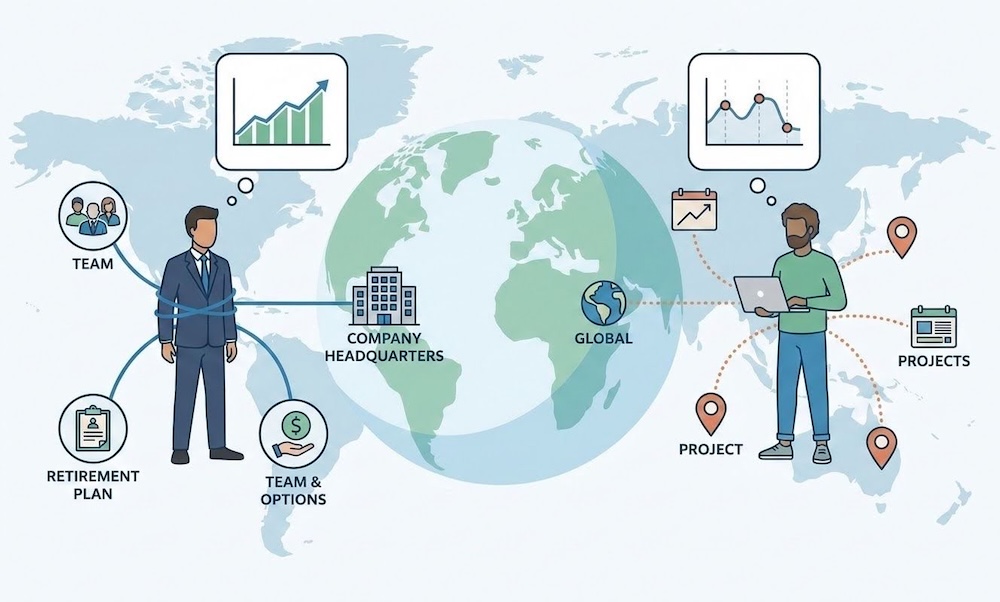
An Employer of Record (EOR) is a third-party service provider that legally hires and manages employees on behalf of another company (the client company). In India, the EOR assumes the full legal responsibility and risk associated with employment, even though the day-to-day work, management, and direction of the employee are handled entirely by the client company.
In essence, the EOR India model creates a clear division of responsibility:
| Responsibility | EOR India (The Legal Employer) | Client Company (The Operating Manager) |
| Legal Employment | Holds the employment contract | Directs the employee’s work and tasks |
| Payroll & Tax | Calculates, deducts, and remits all taxes and social contributions | Determines the employee’s salary and bonus |
| Compliance | Ensures adherence to all Indian labour laws, including the new Codes | Manages performance and day-to-day operations |
| Benefits | Administers statutory benefits (e.g., PF, ESI, gratuity) | Manages non-statutory benefits and company culture |
For a foreign company seeking to hire in India quickly and compliantly, partnering with a trusted EOR like Eos Global Expansion is the crucial first step.
Advantages Over Establishing a Local Entity
Setting up a local legal entity in India—such as a subsidiary or branch office—is a process fraught with complexity, significant upfront costs, and a substantial time commitment. The EOR India model bypasses these requirements, providing a faster, more flexible, and significantly less risky path to market entry.
| Feature | Using an EOR India | Setting up a Local Entity |
| Market Entry Speed | Weeks (allowing for immediate hiring) | Several months to a year |
| Cost | Service fee based on headcount | Significant upfront costs (registration, legal fees, office setup) |
| Compliance Risk | Transferred to the EOR | Retained by the foreign company |
| Local Expertise | Built-in (EOR India’s expertise and local infrastructure) | Requires hiring local legal/HR/finance staff |
| Permanent Establishment (PE) Risk | Significantly minimised | High risk of creating a taxable PE |
The sheer administrative burden of entity setup, coupled with the ongoing expense of maintaining statutory registrations, makes the EOR India model the default choice for global companies testing the market, hiring a small team, or avoiding the creation of a Permanent Establishment (PE) for tax purposes.

Navigating India’s Evolving Labour Laws in 2025
India’s employment landscape is undergoing a major legislative shift with the imminent implementation of four new Labour Codes: The Code on Wages, 2019; The Industrial Relations Code, 2020; The Social Security Code, 2020; and The Occupational Safety, Health and Working Conditions Code, 2020. These codes aim to consolidate 29 existing central laws into a simplified, uniform framework.
While full pan-India implementation details are still emerging in 2025, certain key changes will profoundly affect global employers:
1. New Wage Definition and Structure
The Code on Wages introduces a uniform, comprehensive definition of ‘wages’ that is used for calculating Provident Fund (PF), gratuity, bonus, and other benefits. This shift standardises calculations across the country, which is a major move toward easing compliance, but it necessitates careful restructuring of current compensation packages.
2. Expanded Social Security Coverage
The Social Security Code mandates greater coverage for employees, potentially including gig and platform workers. Key benefits include:
- Employees’ Provident Fund (EPF): Mandatory contribution (12% each from employer and employee on basic wages) for businesses with 20 or more employees.
- Employees’ State Insurance (ESI): Provides medical and cash benefits for employees earning up to a certain monthly wage limit.
- Gratuity: Now requires a minimum of five years of continuous service in the same establishment to be eligible, though the new code may allow for a shorter period, particularly for fixed-term employees.
3. The Shift to a Four-Day Work Week (Potential)
The new codes include provisions allowing for a 48-hour work week to be condensed into four working days, meaning employees could work 12 hours a day for four days, followed by three days off. This flexibility is subject to rules notified by individual state governments. For a global company, this means employment contracts and working hour policies must be structured to remain compliant with state-level adoption of this change.
How EOR Mitigates Compliance Risks
The complexity of state-specific rules and the staggered implementation of the new Labour Codes can be a nightmare for foreign companies. An EOR India like Eos Global Expansion completely absorbs this risk:
- Statutory Registration: The EOR holds all necessary registrations, such as the Employees’ Provident Fund Organisation (EPFO) and Employees’ State Insurance Corporation (ESIC), eliminating the need for the client company to apply for them.
- Local Rule Compliance: The EOR continuously tracks and implements state-level regulations and amendments, ensuring the employees are compliant with the specific laws of their working location (e.g., minimum wage changes, public holiday variations).
- Contractual Integrity: The EOR drafts employment agreements that are legally sound under the specific provisions of the relevant Codes and state-level rules, protecting the client company from litigation risk.
India Payroll and Tax Processes Under EOR India
Payroll in India is complex, involving numerous statutory deductions, specific timelines, and annual reporting requirements. A mistake can lead to penalties and interest under the Income Tax Act, 1961.
Key Compliance Requirements
An EOR handles the full lifecycle of Indian payroll compliance, including:
- Tax Deduction at Source (TDS): The EOR is responsible for calculating and deducting the appropriate income tax from the employee’s salary based on their tax slab and applicable exemptions. This is remitted to the Income Tax Department on a monthly basis.
- Social Security Contributions:
- EPF & EPS: Mandatory monthly deposits with the EPFO. The combined employer and employee contribution is typically 24% of the basic salary (12% each).
- ESI: Contributions are calculated on gross salary (lower threshold) and deposited monthly. As of 2025, the combined contribution rate (employer and employee) is approximately 4% of wages.
- Professional Tax (PT): A state-level tax levied on professional income, which the EOR must calculate, deduct, and remit to the respective state government.
- Statutory Filings and Forms: The EOR files essential forms on time, such as quarterly TDS returns and annual returns, and issues the employee’s Form 16 (TDS certificate for salary) for their annual income tax filing.
The Challenge of Dual Tax Regimes
For 2025, employees in India can generally choose between the Old Tax Regime (with more deductions and exemptions) and the New Tax Regime (with lower slab rates but fewer exemptions). The EOR’s payroll system must accurately calculate the tax liability under both regimes to help the employee make an informed choice and ensure the correct TDS is deducted—a nuanced task that requires deep local payroll expertise.
Conclusion: Simplifying Global Expansion with Eos Global Expansion
Hiring in India is a strategic move, but the administrative pathway is littered with compliance risks. For HR leaders and global hiring managers, the need to focus on talent acquisition and business strategy, not on the minutiae of Indian Labour Codes and payroll deadlines, is paramount.
An EOR offers an elegant solution to the perennial foreign company challenge: how to access India’s talent without committing to the costly and complex legal infrastructure.
Your Next Step to Compliant Hiring in India
Stop worrying about EPF thresholds, state-specific Professional Tax deadlines, or the latest interpretation of the new Labour Codes. Learn how Eos Global Expansion helps you hire compliantly in India without setting up a local entity. We provide the secure, compliant, and swift pathway to leverage India’s talent pool, allowing you to focus on your global business objectives.
Contact Eos Global Expansion now. Check our full-range of EOR services here or book a free consultation now.
Photo by Nina Luong on Unsplash