
Key Takeaways
- Global expansion is the structured process of entering foreign markets to access new revenue, talent and strategic positioning.
- Expansion introduces regulatory, payroll, tax and cultural risks that require governance planning.
- Market entry models range from Employer of Record (EOR) and distributor agreements to full entity setup.
- Cultural intelligence and local compliance expertise reduce execution risk.
- Eos Global Expansion supports compliant cross-border hiring and workforce structuring across 27+ countries through its partnership with Hightekers.
Global Expansion Defined: Strategic International Growth for Businesses
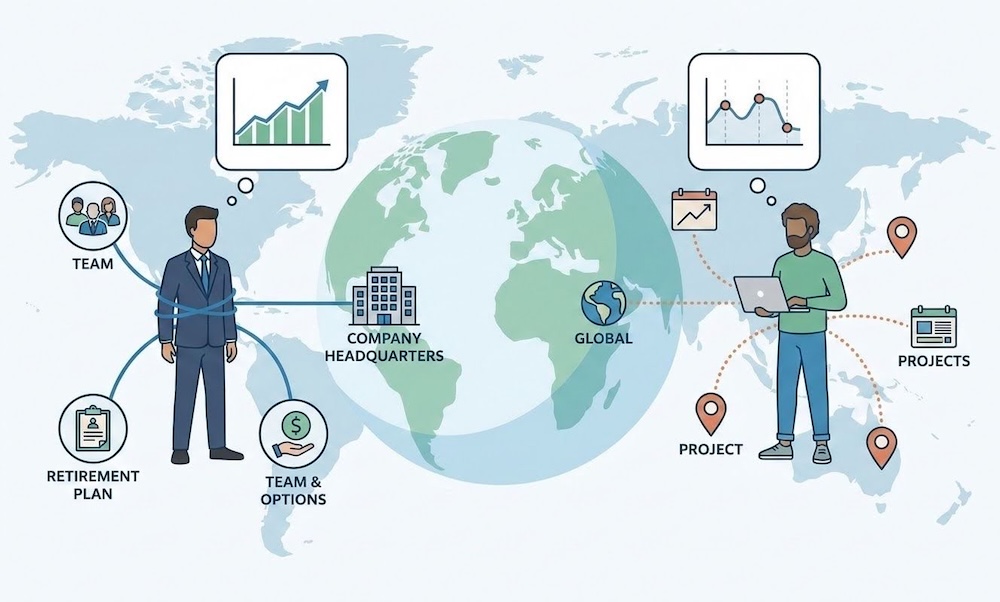
Global expansion is the structured process through which a company enters and operates in foreign markets to increase revenue, diversify operational risk, access international talent, or strengthen its competitive position.
It involves coordinated decisions across:
- Legal presence and corporate structuring
- Employment and workforce models
- Tax exposure and permanent establishment risk
- Payroll and statutory compliance
- Cultural integration and governance alignment
Unlike simple exporting, international growth often requires local hiring, compliant payroll systems, employment contracts aligned with domestic labour law, and cross-border risk management.
For HR, finance, legal teams and executive leadership, expansion is fundamentally a governance and risk strategy that must align with long-term commercial objectives.
For practical workforce deployment strategies, see What Is Cross-Border Hiring & How Does It Benefit Businesses?

Why Do Companies Pursue International Business Expansion?
Organisations expand internationally to strengthen long-term competitiveness and reduce concentration risk.
Common drivers include:
- Access to new customer markets
- Diversification of revenue streams
- Access to specialist or cost-efficient talent
- Optimisation of production and operating costs
- Strengthening supply chain resilience
- Enhancing investor confidence and valuation positioning
According to UNCTAD’s World Investment Report 2025, developing Asia continues to account for a significant share of global foreign direct investment inflows, reinforcing the region’s sustained importance in corporate international expansion strategies.
Global expansion decisions are therefore not purely geographic. They are financial, operational, and governance-driven.
For structured regional workforce sequencing, read Global Workforce Planning for SMEs: Hiring Across Asia Without Complexity.
What Are the Main Types of Global Expansion Models?
Selecting the right market entry model determines regulatory exposure, cost structure, operational control, and speed of execution. The choice affects tax liability, employment governance, and long-term scalability.
Different models suit different stages of international growth.
Common Market Entry Models
| Expansion Model | Legal Presence | Compliance Burden | Speed to Market | Best For |
| Exporting | No local entity | Low | Fast | Product testing |
| Distributor/Agent | No entity | Moderate | Fast | Indirect sales entry |
| Employer of Record (EOR) | No entity | Managed by EOR | Very fast | Hiring without entity |
| Branch Office | Extension of HQ | High | Moderate | Controlled expansion |
| Subsidiary Entity | Separate legal entity | High | Slower | Long-term market commitment |
| Joint Venture | Shared entity | Shared | Moderate | Regulated markets |
Which Global Expansion Model Should Your Business Choose?
Lower-commitment models such as exporting or distributor arrangements prioritise speed and reduced overhead. Entity-based structures offer greater control but introduce tax registration, statutory reporting, and governance obligations. EOR models sit between these approaches, enabling compliant workforce deployment without entity establishment.
How Does An Employer Of Record (EOR) Model Work?
An Employer of Record (EOR) enables a company to hire employees in a foreign jurisdiction without setting up a local legal entity. The EOR becomes the legal employer on paper, while the client company retains day-to-day operational control of the employee.
Under an EOR structure:
- The EOR manages compliant employment contracts aligned with local labour law
- Payroll processing, statutory deductions, and tax filings are handled locally
- Mandatory benefits and social contributions are administered correctly
- Terminations follow domestic legal frameworks
- Regulatory reporting obligations are fulfilled
This structure reduces:
- Time to market
- Entity registration costs
- Permanent establishment exposure during early-stage expansion
- Worker misclassification risk
EOR is particularly suitable when:
- Headcount remains under scale threshold
- Market validation is ongoing
- Expansion spans multiple countries simultaneously
- Internal legal and payroll infrastructure is limited
For a detailed legal and cost comparison between hiring models, read: EOR vs Local Entity Setup: A Strategic Framework for Global Expansion
To evaluate regional expansion sequencing, see: How SMEs Should Sequence Hiring Across Asia: A Country-by-Country Workforce Rollout Strategy
What Are the Most Common Challenges in Global Business Expansion?
International expansion increases operational complexity. The primary risks fall into five categories: regulatory compliance, tax exposure, payroll governance, cultural integration, and cost control.
1. Employment And Regulatory Compliance Risk
Every jurisdiction has distinct requirements covering:
- Employment contracts
- Statutory leave and social contributions
- Payroll tax reporting
- Termination protections
- Data protection and employee privacy laws
Non-compliance can trigger audits, financial penalties, and reputational damage.
For region-specific guidance, see: Navigating Compliance and Local Regulations Across ASEAN: A Guide for Global Employers
2. Permanent Establishment (PE) Risk
Hiring employees, negotiating contracts, or generating revenue locally may create taxable presence under OECD principles.
Legal and finance teams must assess:
- Revenue attribution rules
- Local contract authority
- Employee decision-making scope
- Substance and management location
Unstructured hiring can unintentionally trigger corporate tax obligations.
3. Payroll And Statutory Contribution Complexity Across Jurisdictions
Payroll errors are one of the most common compliance failures in international expansion.
Examples of statutory systems include:
- CPF (Singapore)
- EPF (Malaysia)
- SSS (Philippines)
- Shakai Hoken (Japan)
Errors in contribution calculations or reporting deadlines can trigger penalties, back payments, and regulatory scrutiny. Centralised oversight without local statutory expertise increases enforcement risk.
To understand country-specific payroll and employment obligations before hiring, refer to Eos’s Country Hiring Guides.
For a detailed breakdown of how payroll structure influences expansion risk and cost modelling, read: How Payroll Affects Global Expansion.
4. Cultural And Management Differences
Cultural differences directly affect performance and retention. Common friction points include communication style expectations, leadership hierarchy, and feedback norms.
5. Cost Visibility And Scalability Constraints
Entity setup introduces fixed costs such as legal incorporation fees, tax registration, and local HR staffing. In early-stage markets, these costs may exceed projected revenue.
How Can Companies Overcome Cultural Differences in Global Expansion?
Cultural integration requires structured intervention, not informal adaptation.

Cultural Risk Mitigation Framework
| Cultural Risk Area | Practical Mitigation Strategy | Accountable Function |
| Communication Norms | Cross-cultural leadership training | HR |
| Authority Structures | Clear reporting lines and delegated authority | COO |
| Employment Expectations | Localised employment contracts and benchmarking | HR & Legal |
| Work-Life Norms | Market-aligned leave and flexibility policies | HR |
| Conflict Resolution | Defined grievance procedures aligned with local law | HR & Legal |
Practical Implementation Steps
- Benchmark compensation and benefits locally
- Avoid direct policy replication from headquarters
- Use compliant local employment contracts
- Train leadership on regional management expectations
- Engage local compliance advisors
How Should HR, Finance And Legal Teams Structure Global Expansion Governance?
Successful expansion depends on cross-functional coordination.
HR Priorities: Employment classification review, benefits benchmarking, and workforce scalability modelling.
Finance Priorities: PE risk modelling, payroll cost forecasting, and corporate tax registration analysis.
Legal Priorities: Local contract localisation, regulatory registration compliance, and entity vs EOR structural assessment.
When Is EOR The Right Global Expansion Strategy?
An Employer of Record model is appropriate when speed, risk control, and flexibility are priorities.
EOR is commonly used when:
- Testing a new market
- Hiring small to mid-sized teams
- Avoiding upfront entity costs
- Expanding across multiple jurisdictions
- Reducing PE exposure during early-stage entry
For regional hiring opportunities, see: Top Countries for EOR Hiring in 2026 (And Why Southeast Asia Leads)
Strategic Decision Matrix: Entity Setup vs EOR vs Hybrid
Choosing between EOR, local entity establishment, or a hybrid structure depends on scale, cost tolerance, and long-term commitment.
| Strategic Factor | EOR Model | Local Entity | Hybrid Model |
| Speed of Entry | Immediate deployment | Slower incorporation process | Phased rollout |
| Headcount Scale | Small to mid-sized teams | Larger, stable workforce | Mixed by market |
| Upfront Cost | Lower initial outlay | Higher fixed costs | Balanced investment |
| PE Risk | Lower during early entry | Requires tax modelling | Managed selectively |
| Long-Term Commitment | Market testing | Long-term presence | Progressive scaling |
Global Hiring Coverage Across 27+ Countries
Through its partnership network, Eos Global Expansion supports compliant hiring across more than 27 countries spanning Europe, Asia, Oceania, Africa, and North America.
How Eos Supports International Hiring:
- Providing locally compliant employment contracts
- Managing statutory payroll, tax withholding, and social contributions
- Ensuring adherence to domestic labour regulations
- Mitigating worker misclassification risk
- Supporting compliant onboarding and termination processes
- Advising on permanent establishment exposure
The result is structured, phased expansion — enabling businesses to validate markets, scale headcount progressively, and transition to entity setup when commercially justified.
Conclusion: Global Expansion Requires Structured Risk Governance
Global expansion is a governance decision, not simply a growth ambition. Without structured compliance, payroll alignment, cultural integration, and PE modelling, international growth can introduce more risk than opportunity.
FAQs
1. What Is Global Expansion In Simple Terms?
Global expansion is the process of entering foreign markets to generate revenue, hire talent, or establish operational presence while complying with local laws and tax obligations.
2. What Are The Biggest Risks In International Business Expansion?
Key risks include permanent establishment exposure, payroll non-compliance, worker misclassification, cultural misalignment, and tax registration failures.
3. How Does Eos Reduce Compliance Risk During Expansion?
Eos provides structured workforce planning, local employment contracts, statutory payroll compliance, and governance oversight across 27+ countries. Speak with our global expansion specialists to assess your current hiring structure.
4. Can Eos Support Multi-Country Hiring Simultaneously?
Yes. Eos coordinates compliant hiring across multiple jurisdictions using local entities and trusted partners to ensure regulatory alignment.
5. Is EOR Suitable For Long-Term Expansion?
Yes. EOR can support long-term hiring in non-core markets or transitional phases before entity establishment.
6. How Do We Assess Whether To Set Up An Entity Or Use EOR?
Eos evaluates headcount projections, revenue allocation, tax exposure, and operational commitment to recommend the most cost-effective structure. Speak with an Eos consultant to assess your strategy.