
Key Takeaways
- ASEAN labour laws differ sharply across Malaysia, Indonesia, Vietnam, Singapore, Thailand, and the Philippines, making local compliance essential from day one.
- Most compliance risks arise from non-localised contracts, incorrect payroll calculations, and country-specific tax and social security obligations.
- A regional hiring model backed by EOR or PEO services reduces exposure, accelerates onboarding, and provides consistent governance across multiple markets.
- Eos Global Expansion delivers compliant hiring across 27+ countries with senior specialists guiding HR, finance, and legal teams.
- Companies entering ASEAN should review their hiring model, confirm entity requirements, and standardise payroll governance to avoid disputes and penalties.
Introduction
ASEAN is one of the fastest-growing labour markets, but also one of the most fragmented for compliance. Companies expanding into Malaysia, Indonesia, Vietnam, the Philippines, Singapore, or Thailand must manage country-specific rules for employment law, payroll, tax, and statutory benefits, with most issues arising from non-localised contracts, misclassification, incorrect payslips, or missed filings. Regional hiring is best supported by coordinated Global Employer of Record (EOR) and Professional Employer Organisation (PEO) partnerships that align contracts, payroll, and benefits.
This guide provides a senior-level overview of the key compliance issues across ASEAN and explains how Eos Global Expansion together with Hightekers, delivers compliant hiring in 27+ countries through senior specialists supporting HR, finance, and legal teams.
If you’re evaluating EOR hiring markets, see: Top Countries for EOR Hiring in 2026 (And Why Southeast Asia Leads).

Why ASEAN Compliance Requires a Regional Strategy
Hiring in ASEAN differs sharply from hiring in Europe or North America. Regulations are decentralised, cultural norms influence employment practices, and enforcement across ministries varies by country.
Companies expanding into the region often underestimate:
- Local language requirements in contracts
- Country-specific payroll calendars
- Social security schemes with unique contribution rules
- Entitlements that differ by tenure, role, or location
- Distinct termination rules and dispute processes
- Local work pass or visa obligations that can change with little notice
These variations increase the risk of misalignment between global policies and local labour laws. A fragmented approach—treating each country as an isolated project—often leads to costly mistakes.
Regional coordination through a single partner ensures HR, finance, and legal teams work from the same compliance framework while adapting to each country’s laws.
To understand how global expansion is shifting, explore: Global Hiring Trends 2026: How EOR & PEO Models Are Redefining Expansion.
Key Compliance Areas To Manage
1. Employment Contracts and Documentation
ASEAN markets often require contracts to be localised, using statutory clauses, correct language, and jurisdiction-specific working hours, probation rules, and IP protections. Standard global templates rarely meet local requirements.
Contract misalignment is one of the top drivers of employment disputes in Malaysia, Indonesia, and Vietnam.
2. Payroll Compliance Across ASEAN
Payroll operations vary by country:
- Monthly vs semi-monthly cycles
- Overtime caps and premium rates
- Different tax rates for foreign employees
- Localised payslip formats
- Mandatory reporting to local authorities
Countries such as Indonesia and Vietnam also require payroll data submission through specific provincial portals, adding another layer of compliance.
3. Statutory Benefits and Leave Entitlements
Entitlements differ widely:
- Malaysia: Annual leave by tenure; public holidays vary by state.
- Indonesia: Strict calculation of severance and long-service pay.
- Vietnam: Compulsory social insurance tied to salary components.
- Philippines: Mandatory 13th month salary.
No single benefits structure applies regionally. HR teams must ensure each employee receives the correct country-specific entitlements.
4. Tax, Social Security, and Employer Reporting
ASEAN countries operate distinct social security schemes:
- EPF, SOCSO, EIS (Malaysia)
- BPJS Ketenagakerjaan & BPJS Kesehatan (Indonesia)
- SHUI (Vietnam)
- SSS, PhilHealth, Pag-IBIG (Philippines)
- CPF (Singapore)
Payroll filings, deadlines, and compliance checks vary across departments, requiring regional oversight.
5. Employee vs Contractor Classification
Misclassification risk increases when hiring cross-border teams.
Common triggers include:
- Control and supervision
- Schedule enforcement
- Use of company assets
- Ongoing economic dependency
Indonesia and Vietnam have stricter interpretations, meaning contractor arrangements must be reviewed carefully.
Country-by-Country Compliance Snapshot
Below is a senior-level overview designed for fast reference by HR, finance, and legal teams.
Malaysia – Compliance Essentials
- Contracts must reflect the Employment Act and state-specific public holidays.
- EPF, SOCSO, and EIS contributions are mandatory.
- Foreign employees require appropriate work passes.
- Payslips and payroll deductions must align with monthly reporting schedules.
Check out our Malaysia Employer of Record page for deeper guidance.
Indonesia – Regulations HR Teams Must Watch
- BPJS labour and health contributions apply based on salary.
- Termination compensation (UU Cipta Kerja) is significant and must be calculated accurately.
- Local contracts must be written in Bahasa Indonesia.
- Employers must comply with overtime caps and reporting requirements.
Visit our Indonesia Employer of Record page for details.
Vietnam – Labour Code and Payroll Requirements
- Salary must be structured correctly to determine SHUI contributions.
- Vietnamese contracts are required for compliance.
- Working hours and overtime are tightly regulated.
- Payslips must reflect statutory salary components.
For more information, visit Vietnam Employer of Record page.
Singapore – High Compliance Standards
- CPF contributions apply to citizens and permanent residents.
- Employment Pass rules require accurate job descriptions and minimum salary thresholds.
- Overtime limits differ by occupation.
Explore our Singapore Employer of Record page.
Thailand – Employer Obligations Under Local Law
- Social security contributions are mandatory.
- Termination severance varies by years of service.
- Overtime and rest day rules are enforced strictly.
For expansion support, refer to the Thailand Employer of Record page.
Philippines – Unique Payroll and Benefits Structure
- 13th month salary is mandatory.
- SSS, PhilHealth, and Pag-IBIG are required for all employees.
- Local labour law offers strong employee protection during termination.
See the Philippines Employer of Record page for more.
Risks of Non-Compliance in ASEAN Hiring
Hiring without local compliance alignment leads to financial and operational risks:
- Penalties for incorrect tax or social security filings
- Employee complaints due to incorrect leave, deductions, or public holidays
- Visa cancellations or work pass breaches
- Retroactive liabilities for misclassification
- Disputes arising from poorly localised contracts
- Payroll inaccuracies that create mistrust and attrition
Organisations increasingly prioritise compliance-led hiring models to reduce these risks.
How to Stay Compliant When Hiring in ASEAN
Here are practical steps to maintain compliance at scale:
- Review and update all contract templates for each country.
- Build a region-wide compliance calendar covering payroll, tax, and social insurance deadlines.
- Maintain detailed payroll audit trails.
- Localise benefits, not just contracts.
- Validate worker classification based on each country’s legal test.
- Use local HR teams or an EOR partner to prevent disputes before they occur.
When Is EOR, PEO, or Entity Setup the Right Route?
Understanding the correct hiring model prevents unnecessary cost and compliance risk.
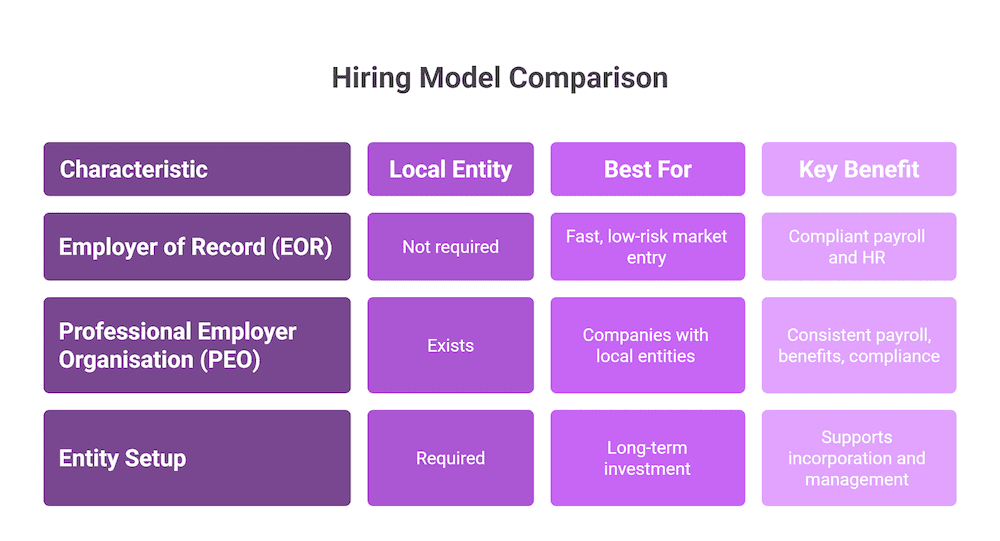
Employer of Record (EOR) – Best for Fast, Low-Risk Market Entry
- No local entity required.
- Built for early-stage hiring, pilots, or distributed teams.
- Fully compliant payroll and HR operations from day one.
Professional Employer Organisation (PEO) – Best for Companies With Local Entities
- Local entity exists but HR needs support.
- Multinational companies use PEOs to ensure consistent payroll, benefits, and compliance across markets.
For deeper insights, read: PEO Market Trends 2026: The Shift Toward Strategic Global Partnerships.
Entity Setup – Best for Long-Term Investment
- Required for large teams or regulated sectors.
- Eos supports incorporation, registrations, and ongoing entity management.
Book a free consultation to identify the most cost-effective hiring model for your ASEAN expansion.
To stress-test your approach and benchmark against current requirements, read: EOR Compliance Checklist for Global Employers in 2026.
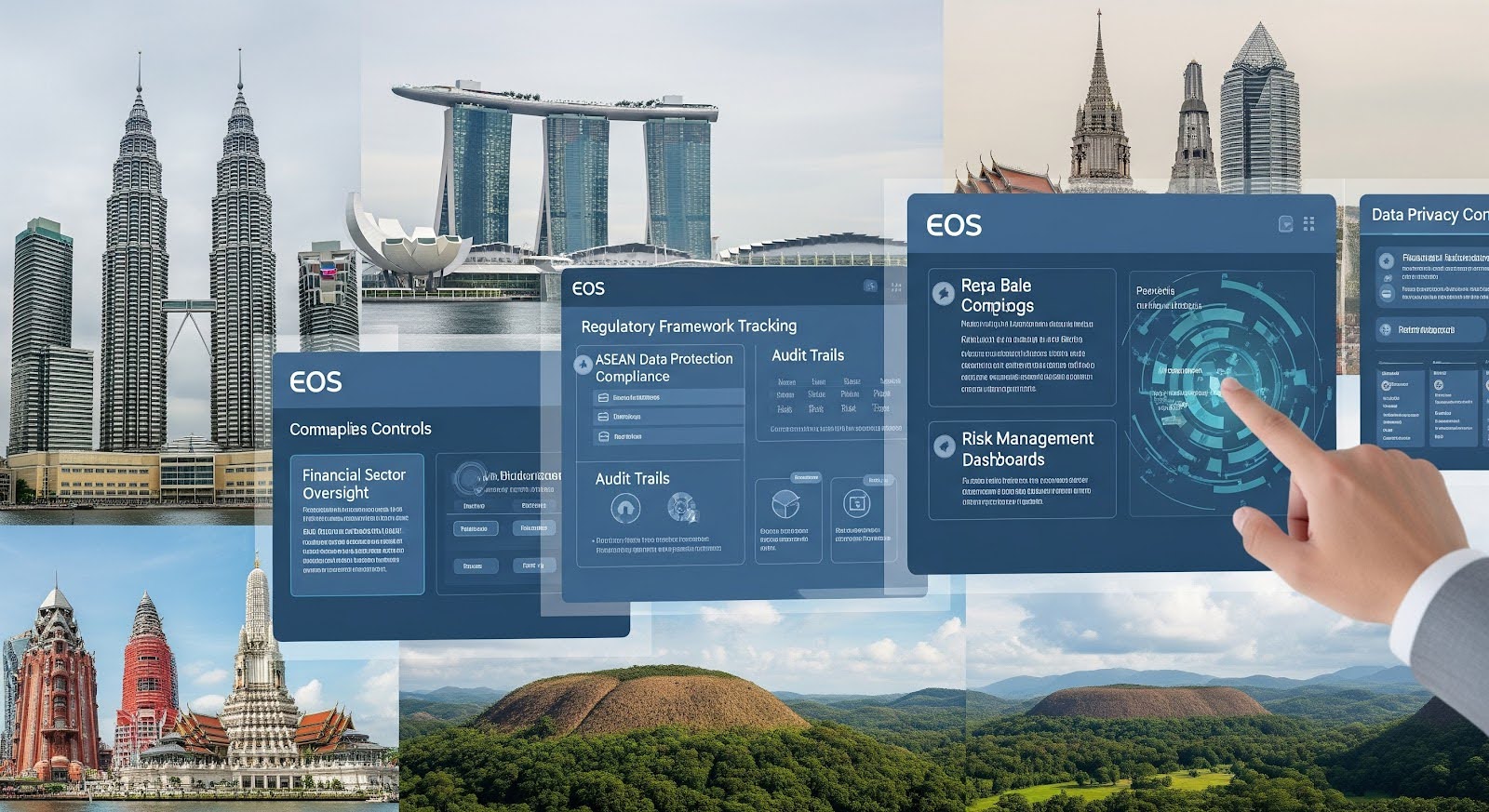
How Eos Ensures Compliance and Local Regulation Alignment Across ASEAN
Local Expertise With Senior-Led Support
Eos’s boutique model ensures clients work directly with senior legal, HR, and payroll professionals. This reduces ambiguity, speeds up decision-making, and ensures adherence to each country’s regulations.
Coverage Across 27+ Countries With Eos
Together, Eos and Hightekers deliver compliant hiring across Asia, Oceania, Europe, Africa, and the Americas. Clients benefit from unified standards and one point of contact across all markets.
Compliance and Risk Mitigation in Every Step
- Contract localisation
- Country-specific payroll compliance
- Aligning benefits to statutory requirements
- Managing work passes and immigration documentation
- Continuous monitoring of labour law updates
Built for Scale Across ASEAN
Companies typically begin with EOR for speed, then transition to PEO or full entity setup once headcount and operations scale. Eos ensures a seamless shift with no disruption to payroll or compliance.
Speak to us to align your ASEAN hiring plan with the right compliance model.
Conclusion
Compliance across ASEAN requires precise alignment with local labour laws, payroll cycles, and statutory benefits. Eos supports global companies with senior expertise, cultural understanding, and coordinated coverage across 27+ countries. This ensures compliant hiring, faster onboarding, and a clear pathway from first hire to scaled operations.
Book a free consultation now to assess your ASEAN compliance readiness.
FAQs
What are the biggest compliance risks when hiring in ASEAN?
Incorrect payroll calculations, non-localised contracts, misclassification, and late tax filings are the most common issues. These lead to penalties, disputes, or licence exposure.
Do foreign companies need a local entity to hire in Malaysia, Indonesia, or Vietnam?
No. EOR allows you to hire legally without an entity. A local entity is only required for long-term operations or regulated sectors.
How does EOR reduce compliance risk?
The EOR becomes the legal employer, ensuring compliant contracts, payroll, tax filings, and statutory benefits while your company directs work.
What payroll rules differ the most across ASEAN?
Payroll frequency, overtime caps, social security contributions, and public holidays vary significantly between Malaysia, Indonesia, Vietnam, and the Philippines.
How can HR, finance, and legal teams maintain consistent compliance across multiple ASEAN countries?
Centralise governance but rely on local expertise or an EOR/PEO partner for country-specific execution. This prevents misalignment between global and local practices.
Contact us for a regional compliance review.
Can Eos support both EOR and future entity setup?
Yes. Eos supports EOR during early expansion and manages entity setup when your headcount grows.
Book a free consultation to plan your next phase.