
Key Takeaways
- By 2026, PEOs move beyond transactional HR outsourcing to co-owning global workforce strategy with HR, finance, and legal teams.
- The professional employer organisation market is forecast to grow strongly this decade as companies seek flexible, compliant HR outsourcing across borders.
- AI and automation in HR increase demand for PEO partners who can combine technology with human judgement and local labour law expertise.
- Data privacy, benefits consolidation, and DEI have become core elements of PEO trends in 2026, not side topics.
- Eos Global Expansion, together with Hightekers, offers a senior-led, boutique PEO and EOR partnership model spanning 27+ markets.
What Are The Key PEO Market Trends In 2026?
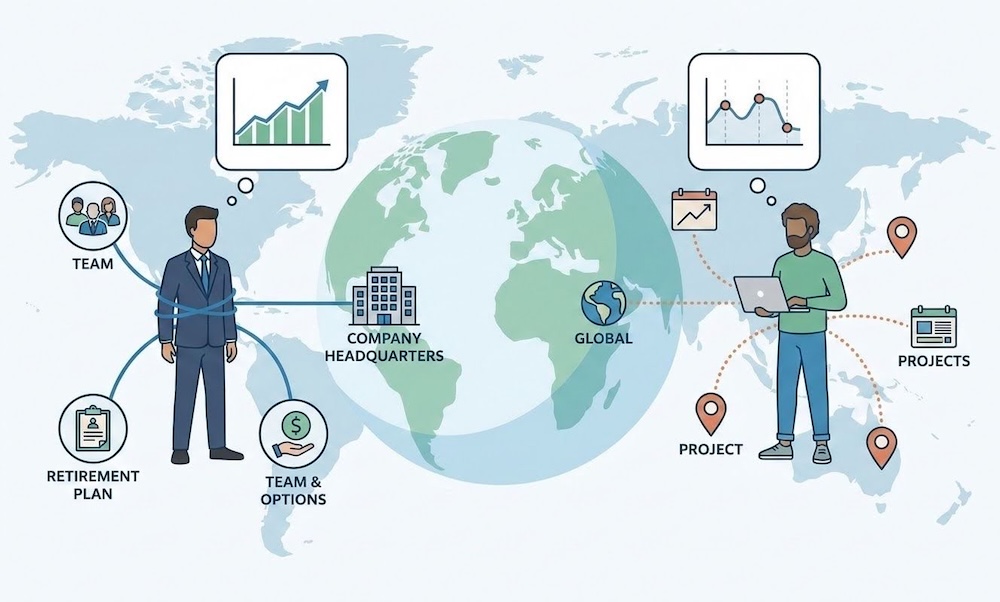
Professional employer organisations (PEOs) are maturing from outsourced HR providers into strategic partners for global workforce management. In 2026, the focus is less on single-country payroll and more on multi-country coverage, co-employment models, and integrated HR platforms that serve HR, finance, and legal leaders together.
Recent market studies project the global PEO market to expand steadily through 2030 and beyond, supported by rising demand for flexible workforce solutions, regulatory pressure, and leadership focus on cost discipline. At the same time, HR outsourcing trends highlight growing interest in specialist partners who can manage payroll, benefits, and compliance while in-house teams concentrate on talent, culture, and leadership.
For organisations planning global hiring, this shift means that choosing a PEO partner is now a strategic decision about your global HR architecture, not a narrow outsourcing transaction. With Eos Global Expansion, that choice is guided by senior specialists who understand both compliance and growth targets.

From Outsourced HR To Strategic Talent Partner
Why HR Outsourcing In 2026 Is More Strategic
HR outsourcing in 2026 is driven by three pressures: multi-country hiring, skills shortages, and a sharper focus on employee experience. PEOs are increasingly asked to support skills-based hiring, learning and development, and workforce analytics, alongside core HR administration.
Rather than simply running payroll, leading PEO providers contribute to workforce planning:
- Advising on market-appropriate job design and grading
- Benchmarking compensation and benefits across countries
- Providing insight on local talent pools and competition
- Supporting restructuring and workforce rebalancing across regions
AI in HR accelerates these trends. As more organisations use AI for screening, scheduling, and HR case management, they rely on PEO partners that can operate secure, compliant workflows and flag risks early for legal and HR leadership.
Read more about How AI and Automation Will Transform Global HR & EOR in 2026
How PEOs Support Leadership Across HR, Finance, and Legal
CFOs and legal directors see PEOs as risk-sharing partners. Co-employment structures allow companies to hire quickly in new jurisdictions while the PEO manages local compliance, payroll taxes, and statutory reporting.
Key areas include:
- Predictable cost models for multi-country headcount
- Clear allocation of employer liabilities and indemnities
- Assurance that labour law updates are tracked and reflected in contracts and policies
- Consolidated reporting on payroll, social security, and benefits by country
Use these insights to benchmark your current hiring model, understand where you may be exposed to compliance risk, and decide whether a PEO, an employer of record (EOR), or a local entity gives the best balance of cost and control.
Explore What Is a PEO? A Guide to PEO Services and HR Solutions for a clear, practical breakdown of how PEO structures work, what risks they share, and when they make financial sense.
How PEO Trends In 2026 Reshape Global HR Strategy
Professional employer organisations are no longer just an operational fix for running payroll abroad. In 2026, leading PEOs sit inside global HR strategy, shaping where you hire, how roles are structured, and how risk is managed across markets. This turns the PEO relationship into a lever for both growth and compliance.
What Should Companies Expect From A Modern PEO?
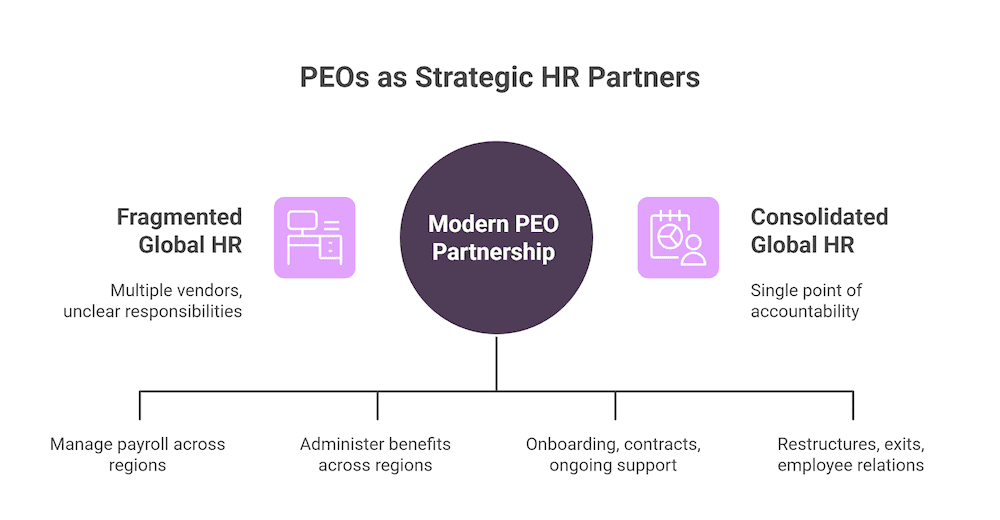
A modern PEO partner in 2026 acts as an extension of your global HR strategy. Typical capabilities include:
- Multi-country payroll and social contribution management
- Benefits administration across regions, including pensions, healthcare, and wellbeing plans
- Employee onboarding, contracts, and ongoing HR support
- Advice on restructures, exits, and sensitive employee relations issues
For HR leaders, this means a single point of accountability for operational HR across several markets. For finance and legal teams, it means fewer local vendors, clearer lines of responsibility, and improved audit trails.
Where PEOs Add Competitive Advantage
PEO trends in 2026 are closely linked to achieving an edge in international expansion:
- Market testing: Build a small, on-the-ground team fast, without waiting months for entity setup.
- Workforce agility: Use co-employment to support project-based, fractional, or part-time roles across borders.
- Operational clarity: Consolidate multiple local HR vendors into a single PEO partner, with aligned processes and reporting.
Explore Eos’s Global PEO and EOR services to see how PEO, EOR, and local entities can be combined in a single, practical expansion roadmap that supports your HR, finance, and legal priorities.
Data Privacy, Benefits Management, and Diversity, Equity and Inclusion (DEI) – Priorities in 2026
Data privacy is now a primary selection criterion for professional employer organisation (PEO) partnerships. HR teams hold highly sensitive personal data, and regulators have raised expectations on confidentiality, data transfer, and automated decision-making in HR processes.
1. How do PEOs manage HR data privacy and security?
Leading PEO partners in 2026 typically:
- Use secure HR platforms with role-based access controls to limit who can see sensitive information
- Store HR and payroll data in line with local data residency and retention rules
- Support the General Data Protection Regulation (GDPR) and local equivalents through documented processes and data protection impact assessments (DPIAs)
- Provide clear, audit-ready reports covering data access, corrections, and retention decisions
This directly supports compliance. Employers gain evidence that HR data is handled in line with regulatory expectations, while still using artificial intelligence (AI) and automation to improve efficiency. Employees see faster HR processes, and their information is handled with care. A strong PEO partner helps the business keep that balance.
2. What Does Strategic Benefits Management Look Like Under A PEO?
Benefits management through a PEO is less about “ticking statutory boxes” and more about designing coherent reward packages across markets. PEOs help central teams:
- Coordinate statutory and voluntary benefits so global frameworks stay coherent
- Monitor benefits costs, especially healthcare and insurance, across regions
- Introduce well-being and flexible benefits aligned with environmental, social and governance (ESG) and talent priorities
By consolidating benefits administration, organisations gain clearer visibility of total reward and can rebalance budgets between salary, benefits, and development where needed.
3. How PEOs Support DEI and Inclusive Global Teams
PEO partners can strengthen DEI by ensuring employment practices reflect both local law and inclusive global standards. Examples include:
- Drafting contracts and policies with strong non-discrimination language
- Advising on inclusive public holiday policies and flexible working patterns
- Supporting equitable parental leave and care arrangements, taking local context into account
For global HR teams, this creates a consistent employee promise across markets while respecting local practice.
Read Global Hiring Trends 2026: How EOR & PEO Models Are Redefining Expansion to see how DEI and borderless hiring strategies work together in real expansion plans.
How To Choose The Right PEO Partner In 2026 – Key Questions For HR and CFOs
Strategic and Operational Fit
HR and finance leaders choosing a PEO in 2026 gain clearer decisions by using a structured checklist. Key questions to ask include:
- Coverage: Which countries are covered today and which are planned?
- Sector experience: Does the PEO understand your industry’s regulatory expectations?
- Technology: How does the PEO integrate with your HRIS, payroll, and finance systems?
- Service model: Who is your day-to-day contact? Are senior experts available when needed?
- Reporting: What standard dashboards and reports are available for HR, finance, and legal?
Evaluating risk, compliance, and cost
Beyond features, decision-makers should focus on:
- Compliance capability: How does the PEO monitor labour law changes and update documents and processes?
- Allocation of risk: How are responsibilities divided in the co-employment agreement?
- Cost comparison: How do PEO fees compare with building internal teams or forming entities in each country?
Use Comparing the Costs: Hiring an Employer of Record (EOR) vs. Setting Up a Legal Entity to benchmark your current approach and apply the same cost, risk, and speed logic when deciding whether a professional employer organisation (PEO), EOR, or local entity is the most effective structure for your expansion.

How Eos Delivers Strategic PEO Partnerships Across 27+ Countries
Boutique Global Coverage With Senior Expertise
Eos Global Expansion, part of the Hightekers Group, provides a combined PEO and EOR platform spanning Europe, Asia, North and South America, and selected markets in the Middle East and Africa. Eos brings more than 15 years of experience across key Asian markets, while Hightekers contributes strong coverage in Europe and beyond.
Eos maintains a boutique positioning. Clients engage directly with senior professionals who understand cross-border hiring, tax, immigration, and cultural nuances in each market. This gives HR and finance teams clear, practical guidance, rather than generic advice.
Compliance, Payroll, And Cultural Insight In Practice
Eos helps organisations:
- Hire, onboard, and pay employees compliantly under local law
- Coordinate payroll cycles, social contributions, and year-end reporting
- Address cultural expectations around working hours, benefits, and management styles
- Align local workforce decisions with global DEI and ESG commitments
Speak with our team about our PEO services today.
Practical Next Steps – Building Your 2026 Global HR Strategy With Eos
Build a 12–24 Month Roadmap
For HR, finance, and legal teams planning ahead, a simple 12–24 month roadmap might include:
- Map markets and headcount: List current and target countries, employee numbers, and worker types (permanent, contractor, fractional).
- Identify PEO use cases: Highlight markets where entity setup is costly, slow, or uncertain and where a PEO model can de-risk entry.
- Align with wider strategy: Ensure PEO use supports your tax, treasury, DEI, and ESG objectives.
- Run a structured selection process: Use the question sets above to evaluate providers against your priorities.
To discuss your specific expansion plans, HR outsourcing mix, or PEO strategy for 2026, book a free consultation now. A senior specialist can review your current arrangements and suggest practical options that balance speed, cost, and compliance across your priority markets.
FAQs:
1. What are the most important PEO trends HR and finance teams should watch in 2026?
PEO trends in 2026 centre on moving from basic HR outsourcing to strategic co-employment that supports global expansion. Leading PEOs now blend compliance, data privacy, and workforce analytics so HR, finance, and legal can plan headcount, cost, and risk together.
2. When does a PEO model make more sense than setting up a local entity?
A PEO is usually more effective when you need to hire quickly in a new market, with small headcount and limited in-house expertise on local rules. As your presence, revenue, or risk profile grows, you may transition from PEO to a local entity or a hybrid mix.
3. How does Eos Global Expansion differ from large global PEO providers?
Eos offers a boutique approach, giving you direct access to senior professionals rather than a generic ticketing system. Legal, HR, and finance expertise leads the conversation, so you receive clear guidance on using PEO, employer of record (EOR), or entities in a coordinated way. Contact Eos to speak directly with a senior specialist about your current global HR structure.
4. In which situations is Eos the right PEO partner for our organisation?
Eos is a strong fit if you are hiring in multiple markets and want one strategic partner to manage risk, compliance, and cultural nuance. It is particularly effective for organisations that need practical advice on when to use PEO, EOR, or local entities as they scale.
Speak to us to review your expansion plans and assess where a PEO model adds the most value.
5. How do Eos and Hightekers work together for multi-country PEO and EOR support?
Eos and Hightekers combine their regional strengths to support clients across 27+ countries under a single, coordinated model. You gain consistent onboarding, documentation, and reporting, with local experts managing day-to-day employment in each jurisdiction.
Speak with our team to map your priority countries against our joint PEO and EOR coverage.
6. How does Eos help us align PEO use with DEI, ESG, and data privacy commitments?
Eos builds diversity, equity and inclusion (DEI), environmental, social and governance (ESG), and data protection into contracts, policies, and processes from the outset. This helps you maintain a compliant, inclusive employee experience while meeting regulatory and audit expectations in each country. Get in touch with Eos to explore how your PEO strategy can support DEI, ESG, and data privacy goals in practice.